In Their Own Book
What the Bible the institutions on this site profess actually says — about children, sexual violence, shepherds who fail, and telling the truth. King James Version, quoted exactly, chapter and verse.
This archive is not a church, and nothing on this page is this site’s preaching. The institutions profiled here — the schools, churches, and denominations in these case files — profess the Bible as their final authority. Most of them use the King James Version. So this page sets out, in that translation, quoted exactly and cited by chapter and verse, what their own book says about the things this archive documents: children and the duty to protect them, sexual violence and who bears its guilt, shepherds who feed themselves instead of the flock, and the obligation to bring hidden things into the light.
The texts are printed beside the record, not above it. Courts decide the cases on this site. But when an institution asks to be trusted on the strength of this book, the book is part of the record too — and the reader can do the comparing.
A note on how to read this page. The Bible does not set out a modern child-protection system, a mandatory-reporting law, or a clinical account of abuse, and these texts are never used on this site to decide whether a real-world allegation is true, to blame a survivor, or to replace safeguarding procedures and the civil authorities. Where a passage is a story rather than a command, it is labeled a narrative of harm — a record of wrongdoing, not a model. The King James text often says “little ones,” “fatherless,” or “shepherd” where a modern reader would say child, orphan, or pastor; the words are quoted as they stand.
The chain of accountability
Ten of these texts — the ones that rotate on this site’s homepage — form a chain, and the order matters. It begins with the offender (Matthew 18:6). It moves to the shepherds who fed themselves while the flock became prey (Ezekiel 34:8; Jeremiah 23:1), and to the authority who knew, and restrained not (1 Samuel 3:13). It reaches the silent witness, who bears iniquity for the silence itself (Leviticus 5:1), and it refuses the excuse — we knew it not (Proverbs 24:12). It sets exposure against concealment (Ephesians 5:11; Luke 12:2), it hears the victim’s cry that no one answered (Deuteronomy 22:27), and it ends where the punishment of crime belongs: with the magistrate’s sword (Romans 13:4). Every link in that chain is documented, in case after case, in this archive.
The duty to protect
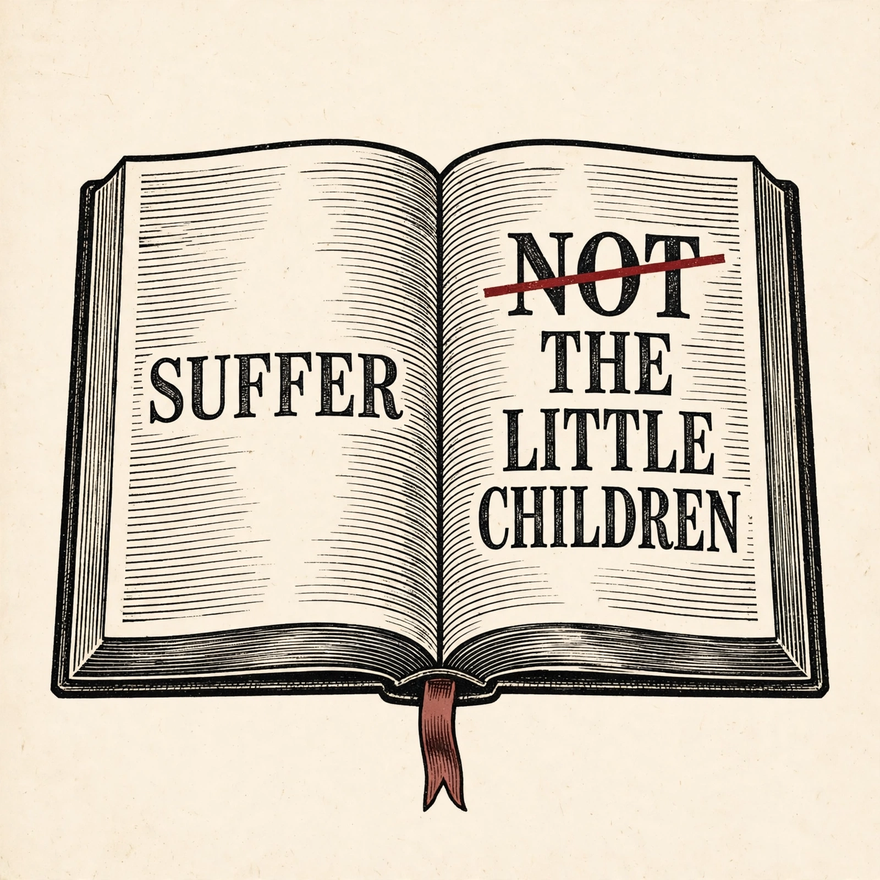
“Suffer little children, and forbid them not, to come unto me: for of such is the kingdom of heaven.”
Matthew 19:14
The command. Children are to be brought near and protected — not barred, managed, or sent away. It stands at the top of every page of this site.
“But whoso shall offend one of these little ones which believe in me, it were better for him that a millstone were hanged about his neck, and that he were drowned in the depth of the sea.”
Matthew 18:6
The severest sentence Jesus pronounces anywhere is reserved for the person who harms a child. In the ancient world a millstone was the great stone of a grain mill — hundreds of pounds of rock. The saying is repeated twice more:
“And whosoever shall offend one of these little ones that believe in me, it is better for him that a millstone were hanged about his neck, and he were cast into the sea.”
Mark 9:42
“It were better for him that a millstone were hanged about his neck, and he cast into the sea, than that he should offend one of these little ones.”
Luke 17:2
“Take heed that ye despise not one of these little ones; for I say unto you, That in heaven their angels do always behold the face of my Father which is in heaven.”
Matthew 18:10
Children are not small, dismissible people. What is done to them — and what is said about them when they speak — is seen.
“Defend the poor and fatherless: do justice to the afflicted and needy. Deliver the poor and needy: rid them out of the hand of the wicked.”
Psalm 82:3-4
“If thou forbear to deliver them that are drawn unto death, and those that are ready to be slain; If thou sayest, Behold, we knew it not; doth not he that pondereth the heart consider it? and he that keepeth thy soul, doth not he know it? and shall not he render to every man according to his works?”
Proverbs 24:11-12
We knew it not is answered in advance: the claim of ignorance is itself weighed.
“Open thy mouth for the dumb in the cause of all such as are appointed to destruction. Open thy mouth, judge righteously, and plead the cause of the poor and needy.”
Proverbs 31:8-9
Speak for the ones who cannot speak in the room where decisions are made about them.
“Learn to do well; seek judgment, relieve the oppressed, judge the fatherless, plead for the widow.”
Isaiah 1:17
“Ye shall not afflict any widow, or fatherless child.”
Exodus 22:22
The verses that follow promise that if the afflicted cry out, their cry is heard — and that wrath follows for those who afflicted them (Exodus 22:23-24).
Sexual violence: the accounts and the law
“But if a man find a betrothed damsel in the field, and the man force her, and lie with her: then the man only that lay with her shall die: But unto the damsel thou shalt do nothing; there is in the damsel no sin worthy of death: for as when a man riseth against his neighbour, and slayeth him, even so is this matter: For he found her in the field, and the betrothed damsel cried, and there was none to save her.”
Deuteronomy 22:25-27
Forcible rape is classed with murder. The guilt is the attacker's alone; the victim bears no sin in the matter at all — and her cry is presumed: she cried, and there was none to save her. The text does not ask why she did not cry louder.
Leviticus 18 and 20 place sexual offenses inside the household — against family members and dependents — among the gravest crimes in the law, most of them capital (Leviticus 18:6-29; 20:10-21). The legal categories are ancient and are not modern law; the principle underneath them is plain enough: the household, and the authority inside it, was never a hiding place.
2 Samuel 13 — a narrative of harm. Amnon, a king’s son, schemes to be alone with his half-sister Tamar and rapes her, over her spoken refusal:
“Nay, my brother, do not force me; for no such thing ought to be done in Israel: do not thou this folly.”
2 Samuel 13:12
Her no is in the text, word for word. He did not listen: being stronger than she, he forced her (13:14).
Afterward her brother Absalom tells her to hold her peace — to treat it as a family matter and say nothing (13:20). And their father, the king, who had both the authority and the duty to judge it, judged nothing:
“But when king David heard of all these things, he was very wroth.”
2 Samuel 13:21
He was angry. The record shows no judgment, no removal, no consequence — anger, and then silence. Two years later Absalom killed Amnon himself (13:28-29). This is the Bible's own account of an institutional cover-up: a powerful household, a known crime, a leader who felt strongly and did nothing.
Genesis 34 — a narrative of harm. Dinah is assaulted by Shechem; her father Jacob, told of it, “held his peace” until his sons came home (Genesis 34:5), and the chapter’s own verdict on the assault is that such a thing “ought not to be done” (34:7). Genesis 19 and Judges 19 likewise record attempted and completed sexual violence as horror. These stories are in the book as records of wrongdoing — never as instruction, and never as comfort for the men who committed or excused the acts.
Shepherds and leaders
“Woe be to the shepherds of Israel that do feed themselves! should not the shepherds feed the flocks?”
Ezekiel 34:2
“The diseased have ye not strengthened, neither have ye healed that which was sick, neither have ye bound up that which was broken, neither have ye brought again that which was driven away, neither have ye sought that which was lost; but with force and with cruelty have ye ruled them.”
Ezekiel 34:4
“As I live, saith the Lord GOD, surely because my flock became a prey, and my flock became meat to every beast of the field, because there was no shepherd, neither did my shepherds search for my flock, but the shepherds fed themselves, and fed not my flock;”
Ezekiel 34:8
The sentence this site is named for. The flock was not lost because the wolves were strong; it became prey because the shepherds fed themselves.
“Thus saith the Lord GOD; Behold, I am against the shepherds; and I will require my flock at their hand, and cause them to cease from feeding the flock; neither shall the shepherds feed themselves any more; for I will deliver my flock from their mouth, that they may not be meat for them.”
Ezekiel 34:10
“Woe be unto the pastors that destroy and scatter the sheep of my pasture! saith the LORD.”
Jeremiah 23:1
“Therefore thus saith the LORD God of Israel against the pastors that feed my people; Ye have scattered my flock, and driven them away, and have not visited them: behold, I will visit upon you the evil of your doings, saith the LORD.”
Jeremiah 23:2
1 Samuel 2-3 — Eli. Eli’s sons were priests who abused their office and the people who came to it (1 Samuel 2:12-17, 22). Eli heard all of it. He rebuked them — and left them in place (2:23-25). The judgment pronounced on his house is not for what his sons did alone, but for his own failure to act on what he knew:
“For I have told him that I will judge his house for ever for the iniquity which he knoweth; because his sons made themselves vile, and he restrained them not.”
1 Samuel 3:13
“And therefore I have sworn unto the house of Eli, that the iniquity of Eli's house shall not be purged with sacrifice nor offering for ever.”
1 Samuel 3:14
Knowing, and restraining not, is its own named sin in this book — and no offering washes it out.
“But he that is an hireling, and not the shepherd, whose own the sheep are not, seeth the wolf coming, and leaveth the sheep, and fleeth: and the wolf catcheth them, and scattereth the sheep. The hireling fleeth, because he is an hireling, and careth not for the sheep.”
John 10:12-13
The hireling's test comes when the wolf does. What a leader does at that moment — stay, or protect himself — is the whole of the description.
“My brethren, be not many masters, knowing that we shall receive the greater condemnation.”
James 3:1
Teachers and masters — the word is the one a school would use — are warned that their judgment is the greater one.
Truth-telling and accountability
“And have no fellowship with the unfruitful works of darkness, but rather reprove them.”
Ephesians 5:11
Reprove: expose. The instruction is not to distance quietly, manage internally, or wait for it to pass — it is to bring the work of darkness into the open.
“For there is nothing covered, that shall not be revealed; neither hid, that shall not be known.”
Luke 12:2
The promise every sealed file on this site is measured against.
“For he is the minister of God to thee for good. But if thou do that which is evil, be afraid; for he beareth not the sword in vain: for he is the minister of God, a revenger to execute wrath upon him that doeth evil.”
Romans 13:4
In this text, punishment of crime belongs to the civil authority — the magistrate with the sword — not to internal church discipline. A crime reported to the police is not a failure of faith; it is the order this passage describes.
“And if a soul sin, and hear the voice of swearing, and is a witness, whether he hath seen or known of it; if he do not utter it, then he shall bear his iniquity.”
Leviticus 5:1
A witness who stays silent bears iniquity for the silence itself. Knowing and not uttering it is the offense.
“And judgment is turned away backward, and justice standeth afar off: for truth is fallen in the street, and equity cannot enter. Yea, truth faileth; and he that departeth from evil maketh himself a prey: and the LORD saw it, and it displeased him that there was no judgment.”
Isaiah 59:14-15
A society described at its lowest: truth fallen in the street, and the honest made into prey — the same word as Ezekiel's flock.
Paul likewise rebukes a congregation that tolerated known sexual wrongdoing in its midst and was complacent about it, rather than mourning and removing the man (1 Corinthians 5:1-2, 13). The caution that belongs with that text is stated on this site wherever it is cited: congregational discipline is not a substitute for reporting abuse to the authorities.
Two texts, handled with care. Matthew 18:15-17 describes a process for confronting wrongdoing inside a congregation, and it is part of this record for completeness — with a warning this archive insists on: it must never be used to pressure a survivor into a private confrontation with the person who harmed them, and it is no substitute for safeguarding or for the civil authorities. Where institutions have used “Matthew 18” to keep abuse in-house and quiet, they have used it against its purpose. And 1 Timothy 5:19-21 — which concerns accusations against elders, and also commands that those who sin be rebuked publicly and that nothing be done by partiality — is carried on this site as a reference only. It is not a license to discount evidence, demand impossible proof, or slow-walk a report; it never overrides reporting a crime.
All quotations are from the King James Version (public domain), verified against the KJV text before publication. If any quotation on this page is found to differ from the KJV, it will be corrected in place under the archive’s Standards — the same standard applied to every other fact on this site.